Inspiration Lacking
My brain is on holidays as well.

Solitude: the fine art of intentionally doing nothing for extended periods of time. As a Christian discipline, its understood as a way to separate yourself from the busyness and noisiness of this world. It is to be quietly still in God's presence, and through this quiet stillness, to actually be open to God's voice and presence. The world is a busy place, and we love the noise and activity. Have we considered the effect of that noise and activity on our ability to hear from, and respond to God?
Monks in ages past would literally flee society: literal solitude. Solitude will look different for us in our modern age, but the glaring importance of it remains.
A book I've currently been reading struck me as a moving reminder as to why we must continually seek God in the stillness of our hearts:For inner silence depends on a continual seeking, a continual crying in the night, a repeated bending over the abyss. If we cling to a silence we think we have found forever, we stop seeking God and the silence goes dead within us. A silence in which He is no longer sought ceases to speak to us of Him. A silence from which He does not seem to be absent, dangerously threatens His continued presence. For He is found when He is sought and when He is no longer sought He escapes us. He is heard only when we hope to hear Him, and if, thinking our hope to be fulfilled, we cease to listen, He ceases to speak, His silence ceases to be vivid and becomes dead, even though we recharge it with the echo of our own emotional noise.
Thomas Merton
Thoughts in Solitude
The Christian faith is about a relationship, may we be ever attentive and ever vigilant.See my books on solitude
I've made the move to Google's new Blogger Beta, so what you'll notice is the new labels. Each post I write can be assigned labels, which you can think of a way of tagging all my posts.
So for example my previous post was tagged: article, chinese and culture. By clicking on any of labels you can see all my other posts with similar tags.
I plan to be blogging more these days, for whatever reason the juice is simply flowing. I'm not really a fan of my current colors/layout however, expect a makeover coming soon! I'm an obsessive compulsive minimalistic. Flickr has a photo group of neat web designs, hoping to draw some inspiration from there. Cheers!
Its sort of like being beat up. Well sort of anyway. You feel a bit spacey, and there's some difficulty in focusing that can be accompanied by head throbbing. Not to mention the temperamental effects including impaired patience, mild unhappiness, loss of judgement, and just feeling plain drained. Its not a great state to be in. This is the world of sleep deprivation. Its a good reminder to know that sleep deprivation is used in torture. Suddenly the stupidity of self inflicted sleep deprivation grows in magnitude. There's something to be learned here...
Reflecting on this has reminded me of the clear depravity and brokenness of man. I constantly mess things up. I rarely know what's best for me, and even when I do, I have an uncanny history of choosing otherwise (sleep deprivation). This goes across the board though, don't forget that we're a species that lets 40,000 children starve every day, kills millions in wars, and causes countless broken relationships and families.
This is where life's biggest questions and conflicts begin: understanding there is something very wrong with us. This is why my faith (Christianity) is so mind-blowingly relevant to me. It meets me where I am: one who is hopelessly depraved and broken. Our attitude upon recognizing this should be one of humility. Its very easy for Christians (well anyone) to become proud and cocky. I think this is only possible when we forget our place. We are not in a place of strength of power, but of weakness and need. This is the most fundamental of truths in what it means to be a Christian. For it was in that place of weakness and need that God met us, it is where God saved us. Our humble recognition of that is where we need to begin, day after day.In the economy of mercy
I am a poor and begging man
In the currency of grace
Is where my song begins (Economy of Mercy - Switchfoot)
Who am I? Over my travels I constantly met people of different nationalities/ethnicities. After learning each others' names the next question is always "where do you come from?" or essentially "what are you?" My reponse was complicated. If I said "I'm Canadian", they would sort of peer at me strangely, since they're really asking about type of Asian ethnicity I was. If I said "I'm Chinese", they would be puzzled by my fluent English and North American mannerisms. What I eventually found is that "Canadian Born Chinese" (CBC) really is the most accurate, albeit a bit longer (and thus harder for non-native English speakers to immediately understand). The problem is I'm not fully Canadian or Chinese. The Chinese have a slang for me, 竹星仔 'jook sing jai' (literally "bamboo star boy"). This term is used to say that just as bamboo appears in independent sections, I am such a section. Thus I do not connect with either the section that grew before (Chinese) or that which is growing after(my Canadian side). Rough.
The last couple years I have yearned to find my cultural identity, this post is about how this journey started.
The book The Joy Luck Club by Amy Tan absolutely floored me. The book is a collage of the stories of 4 Chinese couples and their 4 CBC daughters living in the US. Jing-Mei Woo(a CBC), the main character, goes through her journey of finding cultural identity. Her mother passes away, and Jing-Mei discovers she has long lost sisters in China who have never met their mother. The other parents tell Jing-Mei she must tell her mother's story to these sisters: who the mother was, all that she had suffered, and all that she had done for these lost sisters. The daughter is at a loss for words, and stutters that she wouldn't know what to say... she is torn between feelings of shame, guilt and confusion. She always argued with her mom, always thought poorly of the Chinese way of doing things, and really never understood or appreciated the Chinese way of things. It was with a deep sadness that I empathized with Jing-Mei.
Since then I've been trying to get more exposed to my parent's culture. This involves getting back into learning Chinese, watching Chinese movies, reading books, but much more important than all this - simply having an open, receptive attitude.
Understanding one's culture identity is incredibly important for growing as a person. To know who one is, one must know where one came from. For almost all of us, that's learning about our parents' culture and background. Those by far are the greatest influence on our core values, perspectives, temperament, communication style, morals, etc etc I could go on.
As I grew in my friendships in Austria it was so enriching to encounter different cultures - the conversation that comes out of it causes us to learn to identify our own culture. So when I explained that I was 24 but still lived a home (one of the few amongst our group) I had to think about why that is, and why in CBC culture this was actually almost always the case.
There have been ups and downs in this journey. Culture is a tricky, and quite vague really. I'm reminded when my whole family sits around the dinner table (myself, 2 older CBC sisters, dad born in India, moved to Hong Kong as a teenager, and mom born near Canton and moved to HK in early twenties). We're all different. We're all really really unique ("really" used for emphasis, really you can only be unique or not - really). Culture is a convenient generalization, but really we all exist on a cultural spectrum, with varying similarity and variance.
So this is where I am - learning about who I am, and where that comes from. God has made us with so much cultural variety. And our culture is something we're all proud of, and the thought of losing culture seems both sad and shameful. This isn't the case though - our culture simply changes. Yes its true my Chinese culture is definitely watered down, and likely my children (well, pending children) will retain even less traditional Chinese culture. There will be something in its place, something different - but also something worth treasuring and being proud about.
And if I persevere, perhaps I will not find myself as flustered as Jing-Mei. Instead I will be proud to tell of the culture from which I come from. If I also persevere as a student of culture, hopefully I will be able to fairly evaluate different cultures, and take from the good, and keep from the bad. As a Christian this will also mean what God's culture is like, what are His values and perspectives.
What about you? Tell me about your culture.
My Books tagged with 'Chinese'
My Links tagged with 'Chinese'
Everyone dies. If we call approaching death "dying", then it would follow that we are all dying. Now for the Christian readers they would argue for rapture-related exceptions but for the sake of discussion today let's not go there.
Dying is rather significant (at least somewhat significant) - so what are we doing about it? Do we think about it? Are we aware - and have we come to grips with this reality? I fear our answers to such questions. I know for me (and I suspect most of us) death seems so distantly irrelevant. Which is sort of silly, we think so much about other upcoming events in our lives: getting a driver's license, becoming an adult, getting married, etc. What should death mean to us?
There's a inherent sadness that I experience as I ponder death. Certainly those religiously minded yearn for the "next life", but we all want to experience things on earth. I would like to grow personally, perhaps experience marriage, travel the world, learn a Bach cello suite, pee off a ridiculously tall tree, and the such. To think of losing those opportunities forever makes me sad. So we cling to life, and we cling hard.
Let us not forget what is worse than death, and that is watching others die. I have yet to experience the sorrow of having a close one pass away. But in terms of myself, even at my young age I have become aware of how mental capacity, physical health and ability quickly decline. There's such insecurity and fear in that - to imagine one's self losing power, ability and throughput. As I've watched my parents grow old I've seen this firsthand, and know should I live to be old I surely face the same.
But it doesn't end there. I do not regret thinking about death, because it helps me treasure life even more! That the sunlight upon my face feels that much more vibrant! The joy of laughing with a friend or enjoying the peacefulness of a quiet walk. The become so much more real, so much more valuable. So I am glad to have thought about physical death. I am glad for what you've taught me. Yet regret arises for I know I could have done more. I should have done more. This is why I will remember you, and what your short and simple life has taught me. Thank you Mr. Grasshead.
The author does not wish to portray any insensitivity to the death of loved ones. Rather just the contemplation upon the simple life and death of a plant. Well in this case a rather large number of plants. The author doesn't actually know how to refer to a single grass. He just says "there's some grass". I mean, some people use "blade", but that's in reference to the leaf structure, not the plant itself. "A grass" perhaps is most accurate, but I digress.
The author currently resides in Winnipeg, Canada and spends some of his free time practicing grass-revival techniques, mostly involving water.
Life is filled with all sorts of changes and experiences. I can ask all sorts of difficult questions trying to evaluate the past - should I have done X? Why did I leave Y? Did I ever consider Z?
This brings up the discipline of contentment. I just started a new job. Could my cubicle be nicer? Sure. Could it be worse? Again, sure. Could my salary be better or worse? Sure. I am not attempting to trivialize circumstances, rather I am challenged to consider what it means to seek contentment.
Ascetics and masochists aside, I do believe contentment is a good and important thing. However it is an incredibly variable thing. Some days I believe I need some very expensive item that is really snazzy and I will be content. Other times on a hot day, all it takes is to sit in some shade and enjoy some cool water.
What matters is one's standard for contentment. Person A can be content with a $10 bottle of wine, while person B cannot be content with less than a $100 bottle of wine. I personally think A is better off. Our society however pushes both person A and B to be discontent. To always crave something more, something better. But how much is enough? How is it possible that our society who gets the top 10% best water, food, shelter, clothing, technology, wealth, healthcare, etc still manages to be discontent and always craving for more?
Simplicity is a freedom. Contentment is a freedom. I for one would rather be content and free, than constantly craving and discontent. People talk about doing financial tip X or saving up for Y to improve one's standard of living. Here's a cheaper (but harder) tip - learn contentment. This brings up many other hard (but incredibly important) issues. If we're people who do wrong things, if we are spiritual beings, then we will crave a much deeper contentment. And that, is something only God (not I) can help you with.
Great art can communicate before it is understood. -T.S. Eliot
I've had more time to explore these things these past weeks. We have the privilege of having easy access to film, literature and music like no generation before us. I have often taken this for granted, forgetting how these forms of art have power to inspire, impact, teach, entertain and allow you to experience such amazing things.
Here's some thoughts and tips that have been on my mind with regards to the arts.
High Art and Low Art
Often people differientiate between high art and low art. An example from music might be trying to compare Mozart and Britney Spears for example. I do concede that (and find it plainly obvious) that Britney and Mozart are on different levels of artistic music. However if we look at our lives, we see that both high art and low art are important. I love to listen to the classical masters, but that's not my bread and butter music. Shakespeare may indeed be beautiful and profound, but most of us need the simpler fiction for our dose of storytelling. A friend put it this way to me: high art is like those special lobster dinners - they're wonderful and special, but not what we live off of. Lets not forget the low art, our bread and butter.
Good Art and Bad Art
Although low art is important, this is different from bad art. Some might protest to this heading, that art is subjective and we cannot determine objectively whether art is good or bad. There is a standard though, if we consider God's example as the ultimate artist. Good art is good for you, bad art is bad for you. Some art reflects beauty, enlightens, or helps us grow as a person, and is good for us. Other art demoralizes, glorifies evil, reduces our humanity, and is bad for us. With the amount of art/media we get exposed to daily, its crucial that we are critical partakers. I'm mostly referring to TV here... lol.
Don't Buy New
Access to art doesn't require a lot of money. It can seem like it as movies often cost $20 and books aren't exactly cheap either. But unless you are super keen on it, or it has been very recently released, there really isn't a need to buy new. Cities have tons of great used book stores (Winnipeg's list), and many shops with used DVDs, CDs, etc. This helps give you exposure to the great classics out there too. Of the last 10 books I've bought, 9 were under $4 (a couple were $0.50), with the other being $7.
Don't Buy at All
Here's an even more obvious money saver. With books guess what, let me reintroduce you to a word most of us have forgotten since elementary school: library. Our tax money goes to pay for it, and for us Winnipeggers we have a really amazing newly renovated Millenium Library. This is the best way to try out a book without being sure if you'll like it. The books I have out: worth $30. Cost to me: nothing. There are somethings money can't buy, for everything else, there's mastercard.
Other great ideas are coming out like movie passes. I currently have one at Movie Village (in Osborne Village) where for $20 a month, I can always have 3 movies taken out and I can swap them as many times as I want. There's also many new mail order options that are very good as well.
The web has free stuff. Old classic writings are available free. For the musicians out there, the web has TONs of places to get free music, or very very cheap music. Here's the simple fact, virtually all classical music is public domain. The cost comes only from the editing and publishing. The web has really made so much more instantly accessible for almost no cost.
And last but not least: borrow and lend. I know, our materialistic society is very trophy-oriented. What I mean is that after doing X, we want to go out and buy something as our trophy/testament to doing X. Hence all the stupid T-shirts (I've been to the top of ________). You don't need the trophy, if the art was good for you then that is the most important thing. Also if you're tired of some of your stuff - why not give it away?
Variety is the Spice of Life
Embrace variety. There's so many genres and artists out there, why not try something new? We inherently love variety, but often because we fall into patterns where we stick to what we know. Make an effort to watch perhaps a historial movie, a documentary, sci-fi, anime, foreign, suspense, etc etc. Then one starts to realize how much great stuff there is out there. Use review sites and just pick out rated movies. I don't generally trust a single film critic, but I'm willing to listen if they're mostloy agreed on whether a film is great.
I think variety is most important for books. A lot of people desire to read more, so they pick a book and try to get through it. Then they get a bit bored or hit a lull and then kind of give up. Instead, I read so much more if I have 3-4 books on my shelf, and a bookmark in each. Then on a quiet evening I have a menu before me to choose from.
For the Christians out there I think this is a great way to add variety to reading the Bible. Reading cover to cover is tough (Leviticus will knock you down like nobody's business), rather I recommend this system:
-one bookmark starting from Genesis
-one bookmark in psalms (read a psalm a day)
-one bookmark starting in the major prophets (Isaiah)
-one bookmark starting in the Gospels (Matthew)
-one bookmark starting in the Epistles (Romans)
Its a nice way to get a cross section of the Bible and keep motivated.
So now what?
Go read a book! Listen/play some music! Watch a film! There's tons of other art out there besides simply literature, music, and film. Come to the Rodin Exhibition with me and check out some sculpture for example. Our workaholic society has a disregard for the quiet, stately enjoyment of art. In its busyness we forget we need art. We are creative beings and need oulets for that creativity, lest we let it die. Go get some, trust me - you'll be better off.
Love to hear about your thoughts/experiences. My friend was recently interviewed and shared some really good thoughts (Link).
More Resources
The web has plenty of offerings when it comes to art, check out what I've come across:
Movie Links
Music: Online radio, Sheet Music Sites
Literature: Sites with Ebooks online
Allan is Currently Tasting:
Books: Manufacturing Consent, Jan Wong's China, Discipleship, browse my libraryshelf
Music: Learning Schubert's (transcribed by Liszt) Der Muller und der Bach, Op. 25 No. 19
Film: Godfather I and II, Trois Coleurs: Bleu, Lawrence of Arabia
It was on. I had brought my A game. It all started with a furious smattering of keys (in a somewhat consequential order), followed by a pause, and further smattering. Again I paused with hand on chin, and then smattered some more. It had good links in it and well thought out paragraphs. I proofread it several times, as to improve on my writing style and word choice. Being the multitasker I was, I was surfing off in another window. Happened to click a link to a PDF file, and then BAM my browser crashes. Thank you very much Adobe Acrobat Plugin. It seemed fated that this is how I would discover that blogger.com doesn't have an autosave feature. Lost the blog post I had laboured for.
The post on Music, Literature and Film will have to wait. Life doesn't have an Autosave... after a blunder we can't just revert to a previously saved reality.
Until then, 3 guesses on what "Fire Exit" is in Welsh, and the first two guesses don't count.
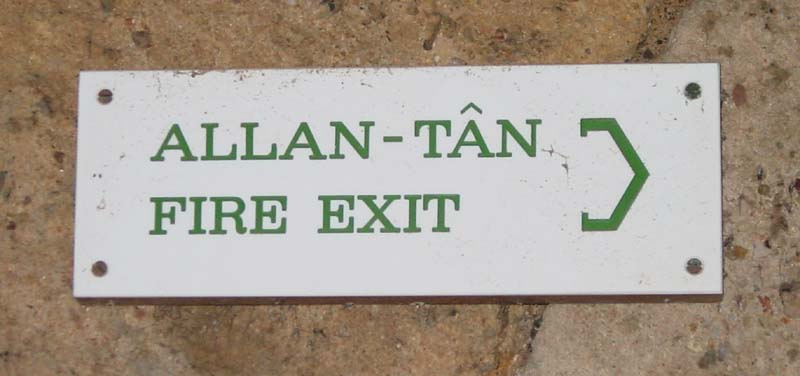 Photo takens by friends from the Schloss
Life as we know it is governed by our perspectives. Something can happen that person A and B both experience, but can exist as completely different experiences based on their perspectives. Our perspectives hold great power over the way we interact with the world. Hence, improving our perspectives (in truthfulnes and wisdom) becomes a very worthwhile activity.
A neat site I came across helped me experience a hypothetical perspective, which gave me a better global perspetive. What if the earth only had a population of 100, yet all the proportions of races, religion, wealth, standard of living and the such remained the same. Check it out at www.miniature-earth.com/ which has a neat flash presentation. This topic of perspectives has been on my mind...
in the days before the anniversary of September 11th, 2001. The question came - what do I know of 9/11? Sure I know the surface media story and the basics, and could regurgitate (roughly) what was replayed over and over and over on the news during that entire month. I can't name any of the individuals that were accused. I can't give any clear explanation on how the twin towers could collapse after burning for under 2 hours... (while in 1975 a fire broke out for over 3 hours over 6 floors with virtually no structural damage)
In fact tons of alternative theories began to abound, easily spread by the advent of the internet. The official 9/11 Commission Report was released three years after 9/11. ABC recently also showed a docudrama The Path to 9/11" was then based off of. Still, many people seem quite convinced that something wasn't adding up.
Before we just label these as mere conspiracy theories, consider: these theories are rapidly gaining support from educated people who actually know a bit of what they're talking about. Consider a movement such as the Scholars for 9/11 Truth. They have quite an educated membership of about 300 including people experienced in advanced research, engineering, physics, etc. The wikiepdia does point out however, notably no one from the American Society of Civil Engineers is yet part of this organization.
Haven't caught up on some of the hard criticisms of the official 9/11 Commission Report? Check out some of these videos, roughly handpicked: Jim Fetzer 9/11 Panel Discussion, the popular Loose Change documentary, an MIT Engineer's take on the WTC collapse. There's countless other organizations, websites, and videos, some of which are more reasonable than the others.
I wish I could have the right and truthful perspective on much of the world's happenings. 9/11 had huge repercussions, perhaps giving ease to the American public allowing its government to declare war on Iraq. That was based on one particular perspective of 9/11, that gave sympathy to the Americans and fueled anger towards the "terrorists".
I think exposing myself to more documentaries/movies/etc can help. Best not to shut one's eyes. My problem is more of fear and this is why I have yet to vote - I find myself a paralyzed agnostic when it comes to such matters. :(
Edit (2006/09/12) - Google Video is hosting an area with tons of eyewitness footage, plus a special film called "7 Days in September". Worth checking out - http://video.google.com/911anniversary.html


